I am not any authority on fitness. As a standard advice, one consults his family doctor before he takes serious exercise.
I am not an athlete that way, but I try slightly more than other city dwellers to exercise. My wife and I attend physical training class twice a week. I finished a half-marathon (slowly) in 2012, and I completed some long distance races occasionally. Yet, I did not finished the HK Standard-chartered Marathon in 2013. So I am an ordinary guy. Some years back, I cut my body weight by 10 pounds over 3 weeks with exercise and dieting several years ago. Please do not copy me that way. It was cruel and probably over-zealous. I also did a bit of readup about exercise. The motivation behind exercise was not as straightforward as some may think. Actually I have a very frail back and I suffered months of backache, before I found a way out to rescue myself through core fitness exercises.
Many people, especially office workers and mothers, consider work and household activity exertive enough to be useful regular exercise. A cardiologist told me, that the volume of household work for SIX families each day, is adequate exercise to keep one fit. I usually joke that real exercise spends resources: some time and a little money. On the other hand, work (brain or household) gains resources but it does not cut our weight.
Weight gain seemed less an issue when one is young, but obesity especially in middle age is now an epidemic across the developed world. In middle age, fat seems to be self-created. Some mothers say that they get fat simply with drinking water. Some men may say that their fatness comes with mere breathing. Yet, everyone remembered mother calling him/her food burners when they were young.
Diet control is important. Yet, even reduction of food to a minimum may not always work. The body senses starvation, and correspondingly responds with shutdown to non-essential energy use. It is therefore better to reduce input of calories alongside boost up to metabolism.
When I was a junior doctor, I was told by a more sporty senior that our metabolic rate reduces by itself when we are 40 years old, and we have to exercise to keep our fire burning. I thought slow metabolism was logical company to aging.
When we enjoy our city life, we sit more than we walk, not to say exercise. When we are about 40 years old, we settle down to a ‘comfortable’ work environment: in a chair before a computer next to a phone, occasionally with use of our pen. Our muscles know that they are not emphasized, and they reduce in size – as an APPROPRIATE adaptation. It is especially worse with upper body and core muscles, as they are hardly needed in a sitting job. The most useful calorie-burning tissue is muscle, and muscles spend less energy with wasting. This is where the reduction in metabolic rate might have come in. When we simply sit down and ‘work’, our metabolic (muscle) fire shuts down and the calorie counter is in positive balance however small meals we take.
Logically, the most efficient remedy to ‘bring up the fire’ in metabolism is exercise to rebuild muscles. It is especially efficient to build upper body muscles, alongside activites which do not need specific teaching – such as jogging, use of cross-trainer, cycling, etc.
Like others who are not very skilled with muscle exercises at the start (me being an ordinary man), I spent much efforts on cardiopulmonary work such as jogging, and thought it was fitness. But then when I read up in recent years, many authorities do not consider cardiopulmonary exercises useful for weight reduction or health indicators alone.
Some authors and trainers point out that these exercises are not very powerful for spending calories, or weight reduction. Actually ‘cardios’ as they are called, are not entirely useless. But our body learns to adapt when the same exercise is repeated. For example, when we train ourselves in jogging, our leg muscles increase in efficiency over time. They burn less vigorously as we thought, because the body learns to gain efficiency.
Many trainers now refer to terms such as ‘circuit training’ or ‘interval training’. The concept of a version (as there are many) is that of a club sandwich. The bread is a cardiopulmonary exercise which is anything which exerts and causes sweating, lasting something like a minute each time. It could be skipping, stepping, cycling, or the like. The contents of the sandwich (the meat and vegetables) are usually 4 to 8 different muscle group exercises and each one also lasts about a minute. This prevents adaptation of muscles to their assigned duty, and thereby ensures maximum use of energy.
In Union Hospital, we started 2 group exercises both at 7 pm on Wednesdays, one for ladies and anther for men. Dr Diana Lam leads the girls with her aerobic exercise type of activity in a seminar room. I take men of the house through circuits in the physiotherapy gym. We have so far tried efforts on managerial ranks and doctors. Initial results are reassuring. I would invite all colleagues to consider joining. Interested colleagues may contact my secretary. We healthcare workers have to look after our own health, alongside our draining work to help others with their health. We work out to maintain muscles and health only. The level of exercise is insufficient to build muscles or endurance significantly. I would of course be very pleased when brothers and sisters exercise more, challenge limits and get very fit.
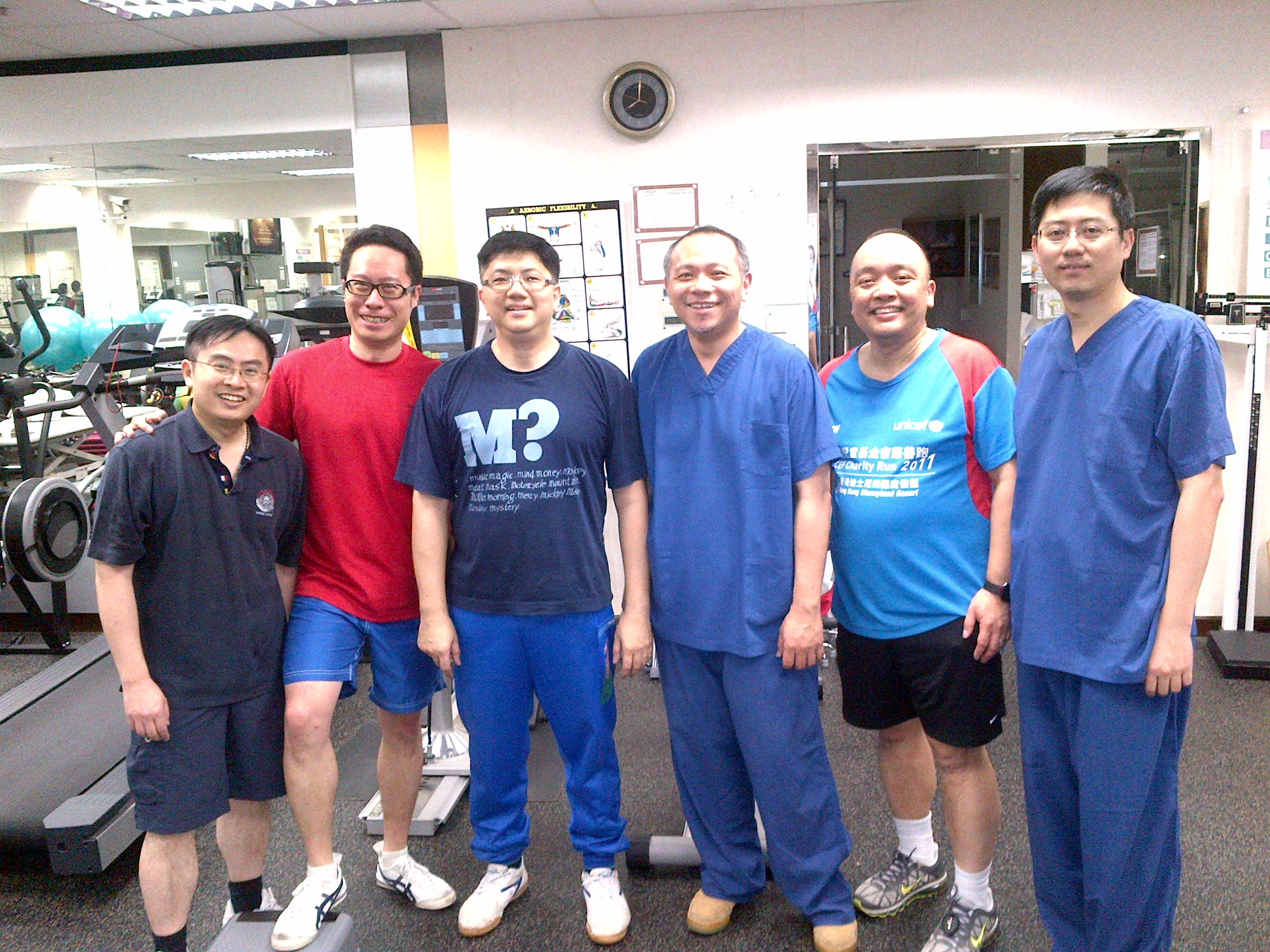
Men taking circuit exercise in physio gym of UH on March 27 2013
Overall in common sense, fitness may be considered a function of elements including health with reduction from impact of diseases, capacities as reflected with cardiopulmonary exertions, muscle strength, and flexibility. I am lucky enough to have gym access, yet body weight exercises are also excellent for health. There is already a lot of exercises one may do at home or the park. Some cardio exercises which do not stress knee structures too heavily may involve the gym bicycle, the cross trainer and the rowing machine.
Towards mid-2013, we would consider moving onto exercises which definitely do not have impact or shock on joints such as the knees for the cardiopulmonary parts. We shall actively consider activity groups to develop big motor functions. Examples include:
The Chest and Push: forms of Push-up
Pull exercises
Exercises on the abdominal muscles in the front
The legs: squats
Lifting with the arms to develop shoulders
It is best to engage a physical trainer. There is a lot of benefit to consult printed or electronic books on fitness & exercise, especially those on core fitness. One book available in electronic format, and therefore may be obtained almost instantaneously, is “You are your own gym” by Mark Lauren and Joshua Clark.
 aresleung.org
0 Comments